



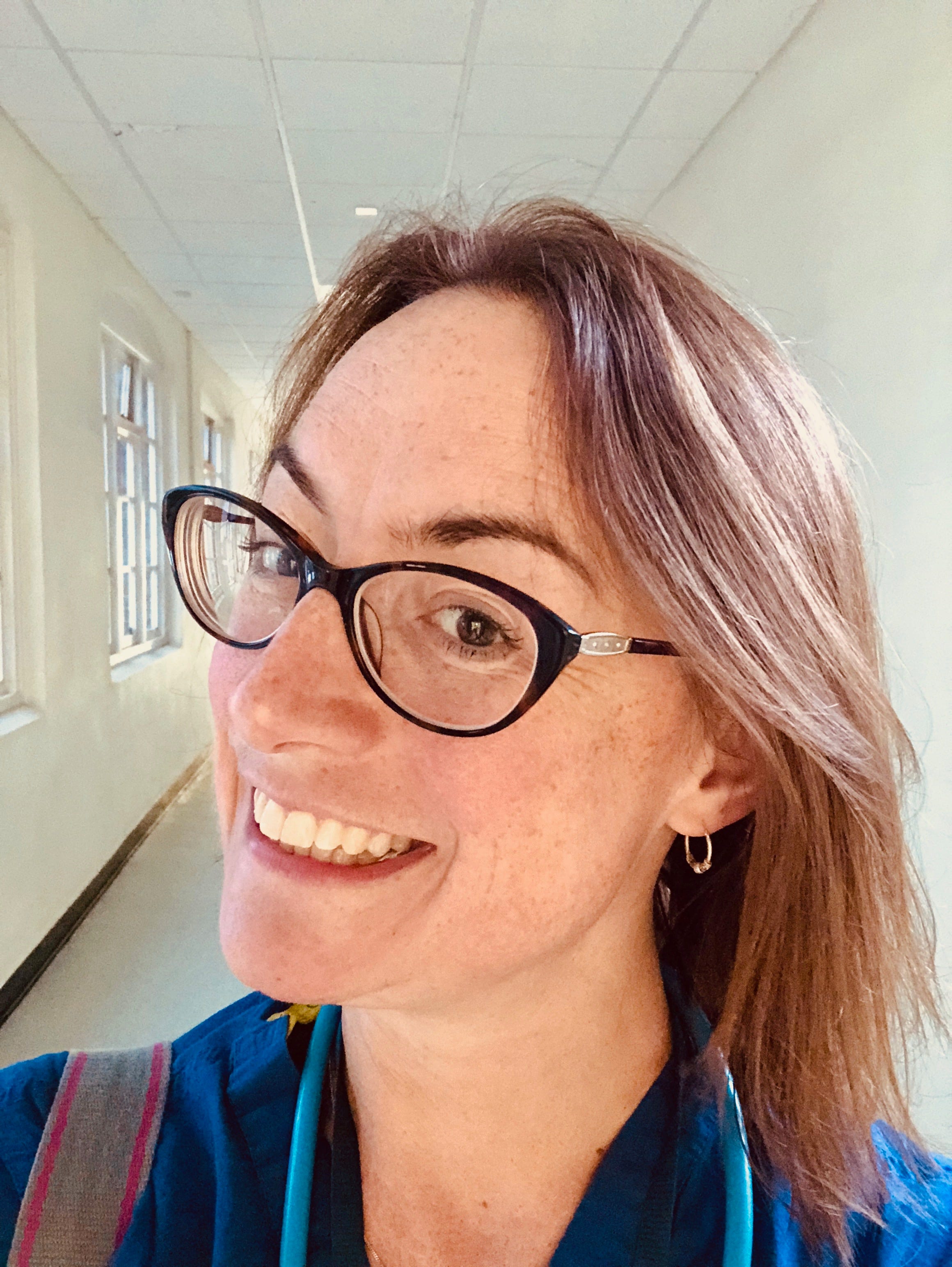
Today I’m chatting with Hannah Harris, a doctor and writer who was recently diagnosed with breast cancer. You may have already read her viral essay A Plea To All Doctors (from a doctor with cancer)—if you haven't, I'd recommend it.
In our conversation, Hannah talks about what she’d go back and tell herself on the day of her diagnosis, the mindset shift that made chemo more bearable, and what it was really like walking back into the emergency room after eight months away. She also has some direct advice for anyone who’s ever held back from asking their doctor a question they needed answered.
Below you’ll find highlights from our chat, or you can watch the full interview by clicking the play button above.

Alison: Can you share a brief overview of your diagnosis and treatment?
Hannah: I was diagnosed with breast cancer last July. I’d found a lump—I was 48, so not yet in the routine mammogram window [Editor’s note: In the UK, routine breast screening typically begins at age 50].
It was invasive ductal carcinoma that had started as DCIS, [an early, non-invasive form of breast cancer]. There was a large area in the right breast and a 43mm tumor had grown from that, so I had a mastectomy. It had also spread to four lymph nodes.
After surgery, I had 16 weeks of chemo—ECT and then paclitaxel—followed by three weeks of radiotherapy. It was hormone-sensitive, so now I’m on ovarian suppression, letrozole, and a CDK4-6 inhibitor.
It has been a journey. I know some people don't like calling it a journey but I don't mind calling it a journey.
How are you feeling now—physically and emotionally?
I’ve been finding it quite hard recently, to be honest.
During treatment, I just battened down the hatches, spent a few months mainly on the sofa, and got through it. But now, nine months on, I’m coming to terms with the fact that it’s not over. You don’t go back to normal.
It doesn’t even feel like a “new normal”—it doesn’t feel normal at all. You've got this little cancer monkey sitting on your shoulder all the time, poking at you, tapping your head, reminding you not to forget.
I think this stage can be really tough. You’re no longer actively treating it, but you’re living with the fear of it coming back.
How do you make sense of that fear?
One of the thoughts I’ve been having a lot is that we’re all going to die in the end. None of us get through this alive.
In a strange way, that’s comforting. We all have to confront this at some point—we’re just doing it sooner than we’d hoped.
But it’s still terrifying.
You’re a doctor. What surprised you most about being on the other side of the desk?
The vulnerability.
As a doctor, you’re the one with the information, the answers, the screen. There’s a position of power in that.
When you’re the patient, sitting there with no screen and no information, just watching the doctor—it’s really scary. You feel completely exposed.
What have you learned about how doctors should communicate?
It's actually much better to be honest, unless you can clearly tell the patient doesn't want that, which usually won't be the case.
The patient sitting there is already terrified it might be cancer. If you skirt around it, use vague language, hide behind terminology like "we need to consider malignancy"—just say it. Say it might be cancer if you think it is.
Patients aren't stupid. Treat them like fellow humans and confront the fear that's already inside their head.
Do you do anything differently now with your own patients?
Yes—I try to show them I’m on their side.
I make eye contact. I don’t just sit looking at the computer while talking. I take a moment to really be present.
I think it’s working. I can notice the difference. It makes for a much better consultation.
What builds—or breaks—trust with a doctor?
You need to feel cared for, and you need to feel the doctor has good knowledge and judgment, and that if they're not sure of something, they'll find out rather than just make it up.
I had a moment where a junior doctor gave me a confident but wrong answer. When the consultant corrected him, my trust just disappeared. Because I thought: if he made that up, what's to stop him making up a drug dose? It's a much more dangerous attribute than doctors seem to realize.
What were you most worried about going back to the hospital?
How different I looked.
My hair, my weight, just managing other people’s reactions. That was what stressed me most.
And it’s true—people comment a lot. “You look so well,” “your hair suits you.” I know they mean well, but it takes its toll.
There’s something about cancer that makes people feel like they have a stake in it. I think it reflects their own fears.
How has cancer changed how people relate to you?
You just want to go back to being treated as you were before, but it’s almost impossible.
Cancer sits above other illnesses. It changes how people see you.
Has your relationship to work changed?
Completely.
I used to thrive in the intensity of A&E. Now I find it a bit much. I don’t want that level of stress anymore.
I’ve actually just taken a new role as a clinical editor for a medical journal. It’ll be quite a lot working from home and just a bit gentler, a different type of work, which I think will be really good for me right now.
What should patients feel empowered to do?
Ask questions. Don’t hold back.
Bring someone with you to appointments. It really helps, because you won’t take everything in.
Don’t worry about being “difficult.” This is your life. Your health. You’re the important one in that room.
And if a doctor isn't giving you the answers you need, you can ask to see a different one. Don't be afraid to do that.
How do you balance politeness with advocating for yourself?
Be polite. You can acknowledge that you might be putting them out, but ask anyway. Never mind if you're being a bit difficult. This is your life, your health. Don't worry about what the doctor thinks of you. It's the main character moment. We need to be assertive as patients.
If you could go back to the day of your diagnosis, what would you say?
This is going to be really fucking hard.
Lean on your friends, they want to help. And focus on the things you love: writing, music, art.
So the people, people and the joy.
What helped you get through it?
Writing.
I joined a writing group on Substack—four mornings a week, Monday to Thursday. A group of women showing up every morning with no judgment. Me there in my little beanie looking terrible. That consistency and community was a wonderful thing to have every day.
It gave me something to hold onto.
Was there anything that made chemo more bearable?
It was more of a mindset.
I tried to think of it as four or five hours just for me, like being on a train or a plane. Time to read, write, rest.
A little pocket of time where I didn’t have to do anything else.
Any simple things that made a difference?
Moisturizing twice a day during radiotherapy—really lathering it on. I used a product called Moogoo and my skin was so good throughout that the radiographers kept commenting on it. That really helped.
And just having a daily routine, like writing in the morning. That structure mattered.
Thank you, Hannah!

And thank you, as always, for being here. I’m so grateful. Do you have any questions for Hannah? Thoughts? Comment below!


